

Do LED Upgrades Make Sense for Small Airports?
by Bulent Ulas
Airport Services Manager, Arc & Spark Electric
Published: April 2026
At a Glance
For a representative small airport with a 1800m (6,000ft) runway, a full LED conversion lands around $200,000 in capital cost.
Across the entire realistic range of small airport operation, the LED conversion does not pay back within the useful life of the fixtures themselves.
At ARCAL usage levels, halogen and LED are essentially tied on annual operating cost once snowplow damage is included.
At higher runtimes, halogen still wins on operating costs because lamp life is long enough that lamp replacements remain modest while the snowplow penalty against LED stays flat.
None of this means LED is bad technology. It means the structural realities of small airports do not support the investment.
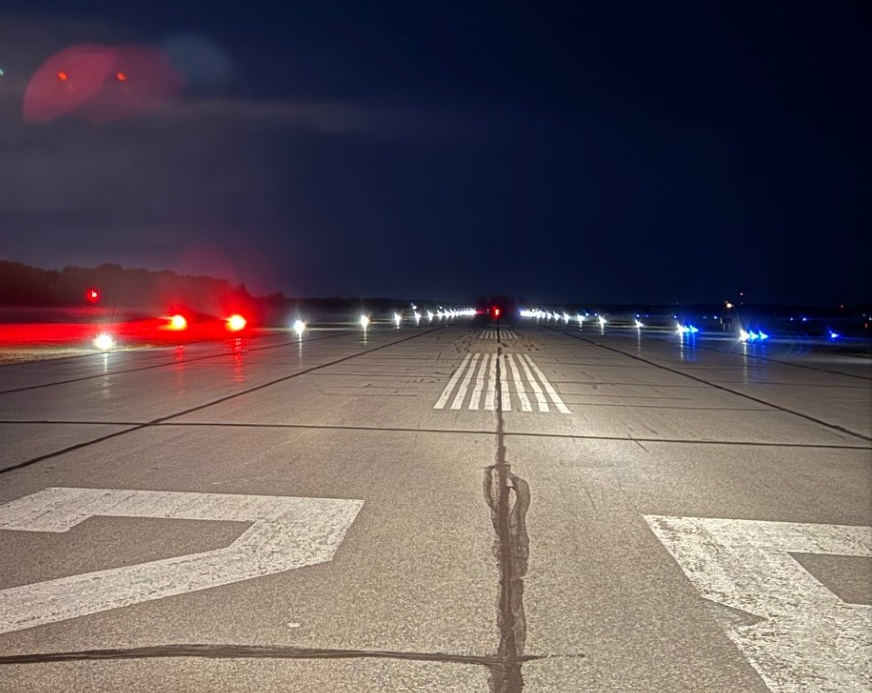
Who This Article Is For?
This article is written for managers and operators of small airports with the following characteristics:
No precision approach runway (Cat I or above)
Medium intensity runway lighting system
An existing, functional halogen lighting system in reasonable condition
Operating in a climate where snow removal is part of winter operations
A Sample Small Airport
To make the numbers concrete, we will use a representative small airport configuration:
Runway: 1800m x 30m (6,000’ x 100’), with medium intensity edge lights (58 fixtures, 45 W each)
Runway threshold and end lights: 12 fixtures total, 100 W each
Taxiway edge lights: 10 fixtures, 30 W each
Total system: 80 fixtures, plus CCR and a single series circuit
Average operating brightness: Step 2 (out of 3 available)
This is a reasonable stand-in for many small regional airports in Canada and similar jurisdictions. If your airport is smaller or larger, the absolute numbers will scale, but the conclusions will not change meaningfully.
The Capital Cost of a Full LED Upgrade
Based on current hardware pricing and realistic labour estimates for a remote site installation, a full LED upgrade for this sample airport comes to approximately $200,000. This figure includes:
-
A new constant current regulator (CCR) compatible with LED loads
-
New LED fixtures for the runway, threshold, and taxiway.
-
New isolation transformers and primary connectors at every fixture
-
Installation labour and project management
-
Logistics and admin costs
Important assumptions baked into this number:
-
The existing primary cable is still usable. If the primary cable has degraded and needs replacement, the cost rises to roughly $275,000 to $315,000.
-
The existing light bases are reusable. If bases are damaged, corroded, or non-compliant with current standards, new bases will need to be installed, adding further costs not reflected in the $200,000 figure.
-
PAPI or APAPI is not included. For simplicity, PAPIs are excluded from the calculation.
In other words, $200,000 is the best case for a realistic conversion. The worst case is materially higher.
Annual Operating Cost: Three Components
Once the LED system is in place, the relevant comparison is the annual operating cost. There are three components that matter:
- Electricity
Lamp replacement (applies to halogen only)
- Snowplow damage repair
We will work through each one.
Electricity
The total lamp load at full brightness is about 4.1 kW. Adding typical CCR and isolation transformer losses brings the actual system draw to roughly 4.9 kW at full brightness. At Step 2, power drops to about 62 percent of full, or roughly 3.06 kW. The LED equivalent draws roughly one-fifth of this, or about 0.61 kW at Step 2.
At a realistic all-in commercial rate for rural Ontario of about $0.15 per kWh, electricity costs scale linearly with the number of hours per year the lights are on.
Lamp Replacement
Rated airfield halogen lamp life is around 1,500 hours at full brightness. At Step 2, real-world lamp life typically extends to about 2,500 hours, because the filament runs cooler. We will use 2,500 hours throughout.
A full set of replacement lamps for the sample airport (58 runway edge at $35, 12 threshold/end at $60, 10 taxiway edge at $32) costs about $3,070.
LED fixtures do not have replaceable lamps and have an estimated lifetime of 20 years, though this may be longer.
Snowplow Damage
At most small northern airports, the single biggest physical risk to airfield lighting is snow removal. Every winter, some number of fixtures get clipped by plow blades, broken by ice chunks, or otherwise destroyed. The damaged fixture has to be replaced entirely.
Representative fixture replacement costs:
Halogen fixture: ~$635
LED fixture: ~$900
For the calculations below, we use 3 damaged fixtures per year, which is conservative for a small airport in a snowy climate. Many operators report higher numbers.
The Numbers Across Realistic Runtimes
Here is what annual operating cost looks like for the sample airport across the full range of how a small airport might actually run its lights. All figures are in Canadian dollars.
| Halogen | LED | ||||||||||||
|---|---|---|---|---|---|---|---|---|---|---|---|---|---|
| Annual runtime | Electricity | New Lamps | Snowplow | Halogen total | Electricity | Snowplow | LED total | LED saves/yr | Payback | ||||
| 456 hr (ARCAL, 5 activations/night × 15 min) | $209 | $560 | $1,905 | $2,674 | $42 | $2,700 | $2,742 | -$68 | Never | ||||
| 1,000 hr | $459 | $1,228 | $1,905 | $3,592 | $92 | $2,700 | $2,792 | $800 | ~250 yr | ||||
| 2,000 hr | $918 | $2,456 | $1,905 | $5,279 | $183 | $2,700 | $2,883 | $2,396 | ~84 yr | ||||
| 4,380 hr (max: every night, all night) | $2,010 | $5,378 | $1,905 | $9,293 | $401 | $2,700 | $3,101 | $6,192 | ~32 yr | ||||
A few things stand out from this table.
At ARCAL usage levels (the realistic case for most small airports), LED actually costs slightly more per year than halogen. The snowplow penalty alone exceeds the combined savings from electricity and lamps. No version of the energy-efficiency argument survives at this usage profile.
At 1,000 to 2,000 hours per year, which would represent a small airport with significant flight training or charter activity, LED begins to show modest annual savings. But the payback period for the $200,000 capital cost still ranges from 84 to 250 years. That is far longer than any airfield lighting system is rated to last, let alone the LED fixtures.
At the physical ceiling of 4,380 hours per year (lights on every single night from sunset to sunrise, all year), LED savings climb to about $6,200 per year, and payback drops to about 32 years. This is the upper bound. No real small airport operates anywhere near this number, but it is worth showing because even here, the payback exceeds the typical LED fixture’s rated life. In other words, even in the impossible scenario where a small airport runs its lights every hour of every night for the entire year, the LED fixtures themselves will start failing by the time the conversion finally pays back.
Why the Conclusion Holds Across the Range
The reason halogen wins across the entire realistic range of small airport operation comes down to three structural facts that do not change with runtime:
Snowplow damage is tied to operations, not runtime. A small airport in snow country loses roughly 3 to 5 fixtures per year, regardless of how many hours the lights are on. The LED replacement cost penalty is permanent, and it is large enough to consume most or all of the energy savings at typical small airport usage.
Lamp life at Step 2 is long. On average, lights are operated at medium brightness, not at full brightness. At Step 2, halogen lamps last around 2,500 hours, which means lamp OPEX stays modest even at high runtime.
The capital cost is fixed and large. $200,000 is the same whether the airport runs 400 hours or 4,000 hours per year. For a small airport that does not generate meaningful revenue, competing with snowplow fuel, runway crack sealing, and other basic maintenance for budget, that capital is hard to justify against any payback measured in decades.
These three facts combine to mean that at low runtime, the energy savings are too small to matter, and at high runtime, the LED fixtures wear out before they pay back.
A Note on Aging Infrastructure
One more point worth mentioning. Every LED fixture contains a small electronic circuit board that converts the incoming power from the series loop into something the LEDs can use. That circuit board is sensitive. It does not like voltage spikes, distorted waveforms, or the minor electrical noise that aging cables and old isolation transformers tend to produce. A halogen lamp, by comparison, is just a filament. It does not care what the incoming power looks like, as long as there is enough of it. You could feed a halogen lamp messy power all day and it would just glow.
This is not a reason to avoid LED as a technology. It is a reason to be honest about the fact that pairing new LED fixtures with original 1980s or 1990s underground cable and transformers can shorten the life of those electronic boards and push up maintenance rates. If your airport is considering LED and your cable and transformers are original to the installation, factor that into the decision rather than assuming the new fixtures will perform the way the manufacturer’s datasheet promises.
Where LED Makes Sense
None of this should be read as a blanket argument against LED. LED airfield lighting is mature, capable technology, and there are plenty of situations where it is the right choice:
Category II/III precision approach runways, where the lighting system is far denser (ALSF-2 approach lights, centreline lights, touchdown zone lights) than a non-precision runway. That density drives up total electricity consumption, multiplies the number of fixtures to maintain, and increases runway closure time for lamp changes, which is a serious concern at airports where runway availability directly affects operations. On top of that, regulatory requirements for Category II and III lighting are strict on the number of allowable failed lights at any given time, which makes the longer service life of LED fixtures a genuine operational advantage. Category I runways sit in a middle ground that deserves its own dedicated analysis, which is outside the scope of this article.
New installations, where the incremental cost of LED over halogen is much smaller, and the infrastructure is built from day one for LED loads.
Projects funded by grants that cover a large share of the capital cost.
Systems at end of life, where the comparison is not “keep halogen” versus “convert to LED” but rather “rebuild as halogen” versus “rebuild as LED.”
Note: A system showing its age is not always one that needs replacing. Targeted repairs and selective component replacement can often extend its life by years at a fraction of the cost of a full rebuild.
The argument in this article is specific to small airports with functional halogen systems. For that profile, LED conversion does not pencil out at any realistic runtime.
A What to Do Instead
For a small airport that fits the profile in this article, the practical path forward is straightforward:
Keep the existing halogen system running. It works, it is cheap to operate, and its failure modes are well understood.
Source lamps from reliable suppliers. Airfield halogen lamp supply remains available through specialty distributors, despite occasional claims to the contrary. Any TP312-compliant halogen fixture can replace an individual failed unit without running into the mixing restrictions that apply to LED conversions.
Keep a modest stock of spare fixtures and lamps for snowplow season. This is the single most effective maintenance investment a small airport can make.
Plan for eventual LED conversion on your own timeline, not a supplier’s. When the existing infrastructure genuinely reaches end of life, or when a grant opportunity covers most of the cost, revisit the question with fresh numbers.
Do not mix LED and halogen within the same lighting group. Transport Canada Advisory Circular AC 300-017 is clear on this point. If you do decide to convert, the smallest unit of conversion is a full lighting group, such as all runway edge lights or all threshold lights at once.
Bottom Line
LED airfield lighting is not the wrong technology. It is the wrong technology for this moment at a small airport. The capital cost is high, the annual savings are small at realistic usage and modest even at the edge cases, and the dominant maintenance expense at small airports, snowplow damage, actually gets worse with LED fixtures rather than better.
The right answer for most small airports is to run the halogen system as long as it is reliable, budget for spares, and reconsider LED in five or ten years when the infrastructure naturally reaches the end of life or when external funding changes the math. That is not resistance to progress. It is simply letting the numbers lead the decision.
All cost figures are budgetary and based on typical Canadian pricing at the time of writing. Your actual numbers will vary based on site conditions, supplier selection, and labour market. The scenarios in this article are intended to illustrate the decision structure, not to serve as a quote for any specific project.
References
Revision History
- April 2026: Initial publication.