
A Practical Method for
Independent PAPI Angle Verification
by Bulent Ulas
Airport Services Manager, Arc & Spark Electric
Published: 2026-03-05
Last Revision: 2026-03-27
Why PAPI Independent Verification Matters
Transport Canada Advisory Circular AC 300-006 requires that PAPI setting angles be verified by an independent method — both at initial commissioning and at regular intervals. The intent is clear: the clinometer used to set the angle should not be the only instrument confirming it.
In practice, this verification rarely happens. The method described in AC 300-006 requires a theodolite placed on or near the PAPI unit, a trained surveyor, and at least two personnel. The equipment is expensive, the procedure assumes the PAPI cover surface is perfectly parallel to the beam (a significant assumption at ±3 arcminute tolerance), and placing a theodolite on the unit risks disturbing the very alignment being verified.
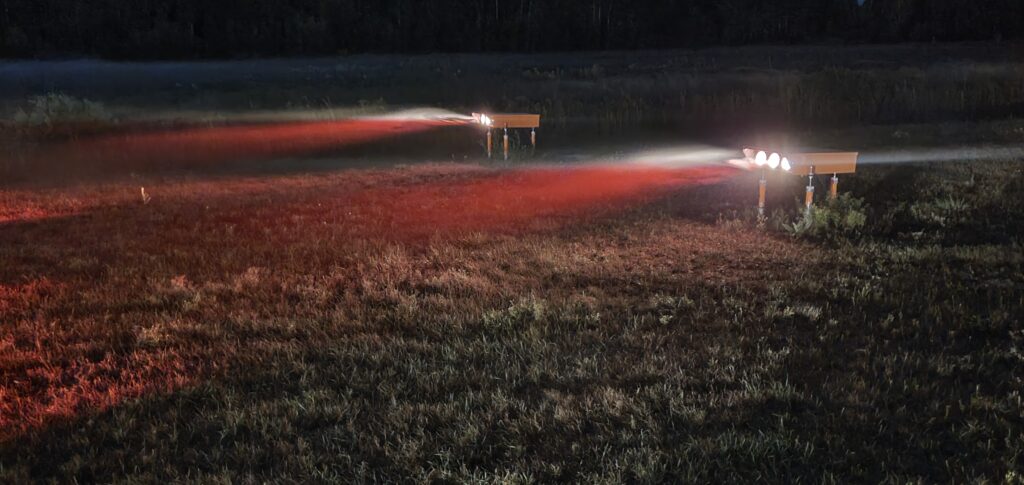
A Simpler Geometric Approach
We developed a method that requires only a laser level, a 5m levelling rod, a laser distance meter, and a digital clinometer — equipment accessible to most airport electrical crews for under $1,000.
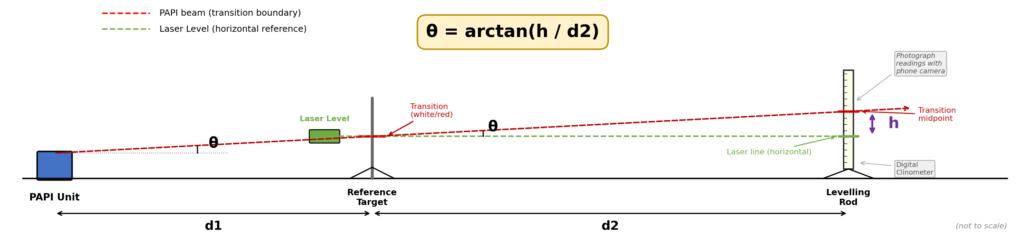
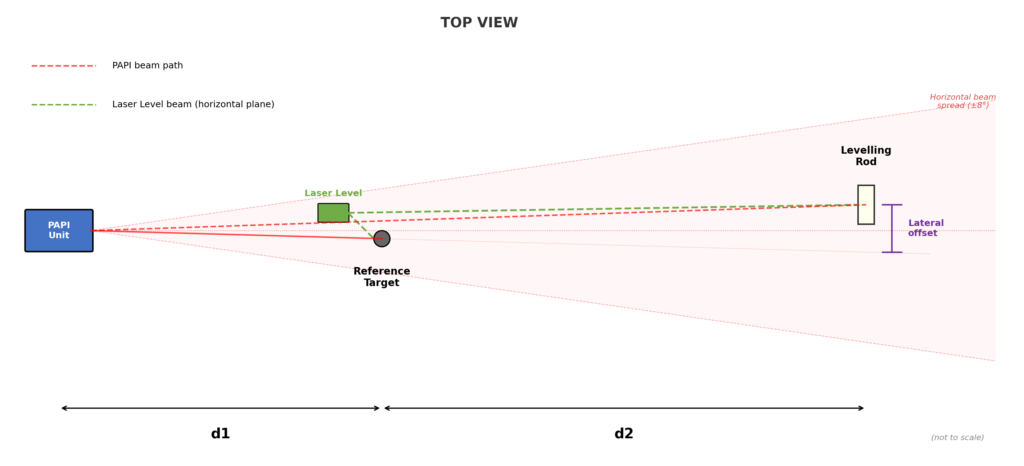
The principle is straightforward. A Reference Target is placed in front of the PAPI unit, and the white/red transition midpoint is identified on it. A laser level is set at that transition height, projecting a horizontal reference forward. A levelling rod is placed further along the beam path, at a minimum distance of 35 metres from the Reference Target. On the rod, the operator reads two positions: the laser line and the transition midpoint. The vertical difference between these readings, combined with the measured distance, gives the PAPI setting angle directly.
The key mathematical property is that the PAPI mounting height and the distance to the Reference Target cancel completely from the calculation. This means no contact with the PAPI unit is needed, no offset measurements are required, and the result is independent of the PAPI’s own reference systems.
Precision Within TP312 Tolerance
A formal uncertainty budget — covering transition identification, laser level accuracy, rod plumbing, distance measurement, lateral offset, and atmospheric refraction — demonstrates a combined method uncertainty of ±0.036° at a working distance of 35 metres. This is within the ±0.05° (3 arcminute) tolerance specified by TP312 5th Edition with a margin factor of 1.39×. The margin improves further at longer working distances.
Download the Full Technical Paper
Version 2.0 is a major revision that includes a formal uncertainty budget with traceable error sources, pre-measurement verification procedures for all instruments, a method comparison with existing approaches referenced in AC 300-006, and an optional spatial filtering enhancement that reduces the dominant uncertainty source and allows shorter working distances. The document is structured as a field procedure for airport electricians (Part 2) and a complete technical basis for regulatory review (Part 3).
Download link:
Revision History
- 27 March 2026 (v2.0):
Major revision. Replaced two-pole method with two-reference laser level method. Added formal uncertainty budget, pre-measurement verification procedures, method comparison, and spatial filtering enhancement. Increased minimum working distance to 35m. Added laser distance meter and digital clinometer to equipment. - 05 March 2026 (v1.0): Initial publication.